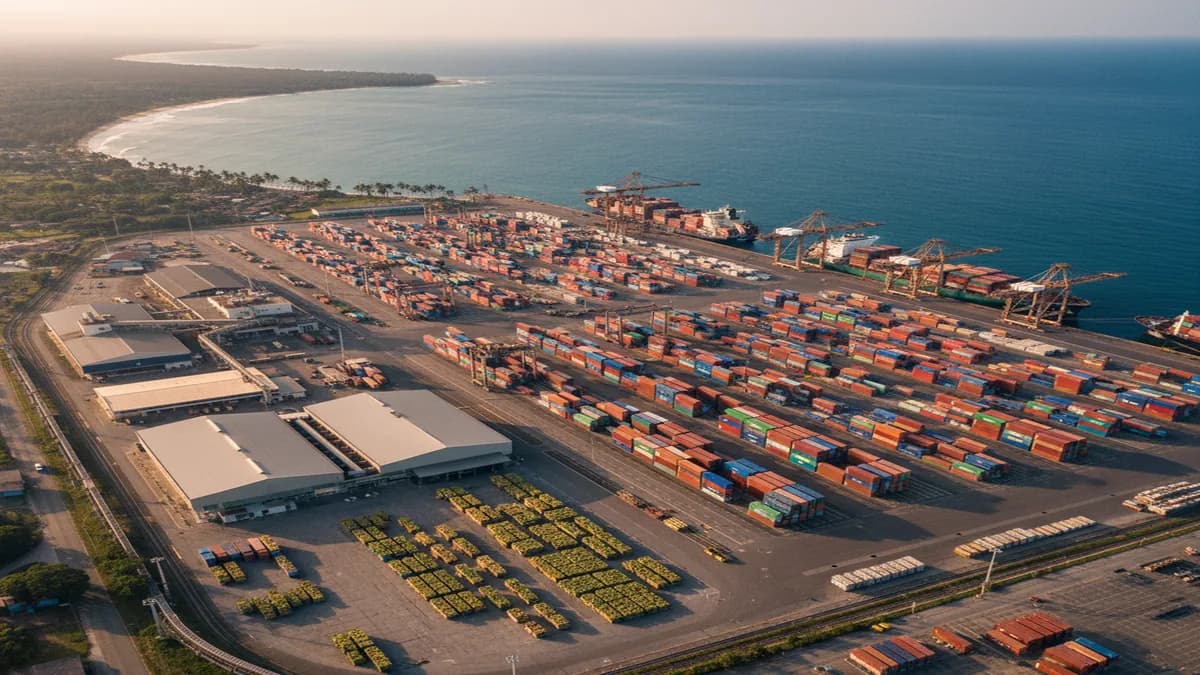
Ecuador Set to Become World's #2 Cocoa Producer — 623K+ MT Projected

Production Milestone
Ecuador is on track to produce over 623,000 metric tons (MT) of cocoa in 2026, positioning the country to become the world's second-largest cocoa producer — surpassing Ghana and trailing only Ivory Coast. The projection represents a remarkable ascent for a country that was the world's seventh-largest producer as recently as 2015.
Global Rankings (Projected 2026)
| Rank | Country | Production (MT) | Share |
|---|---|---|---|
| 1 | Ivory Coast | ~1,800,000 | ~35% |
| 2 | Ecuador | 623,000+ | ~12% |
| 3 | Ghana | ~600,000 | ~12% |
| 4 | Cameroon | ~350,000 | ~7% |
| 5 | Nigeria | ~300,000 | ~6% |
Ecuador's rise is particularly notable because it produces primarily Arriba Nacional (fino de aroma) — a premium variety that commands a 30-50% price premium over bulk West African cocoa. Ecuador accounts for approximately 60% of the world's fino de aroma production.
Cocoa vs. Bananas
In a historic shift, cocoa exports surpassed banana exports in value for the first time in 2025:
| Product | 2025 Export Value (est.) | YoY Change |
|---|---|---|
| Cocoa & derivatives | ~$4.5B | +65% |
| Bananas | ~$3.8B | +3% |
The crossover was driven by record global cocoa prices exceeding $8,000/MT in late 2025 — more than triple the five-year average — caused by severe production shortfalls in West Africa due to disease (swollen shoot virus), aging plantations, and adverse weather patterns.
Growth Drivers
Ecuador's cocoa expansion is driven by:
- Price incentive — record global prices have incentivized smallholder farmers to expand cultivation area and improve agronomic practices
- CCN-51 variety — the high-yield CCN-51 clone, developed in Ecuador, now accounts for approximately 60% of production volume, complementing the premium Arriba Nacional
- Cultivation area expansion — estimated at 650,000+ hectares, up from 500,000 hectares in 2020
- Processing investment — domestic grinding capacity has expanded, adding value before export
ANECACAO and Industry Structure
The Asociación Nacional de Exportadores de Cacao (ANECACAO) coordinates the export sector, which includes approximately 100,000 farming families. The industry structure is heavily smallholder-based, with average farm sizes of 5-10 hectares.
What to Watch
- West African supply recovery — if Ivory Coast and Ghana production recovers, global prices could normalize, reducing Ecuador's export value growth even as volumes increase
- Quality premiums — Ecuador's ability to maintain fino de aroma premiums as CCN-51 volumes dominate will affect per-ton revenue
- Processing capacity — domestic grinding expansion could capture more value-added revenue; current grinding capacity utilization is estimated at ~70%
- Cadmium regulations — EU cadmium limits in cocoa remain a compliance challenge for Ecuadorian producers; the EU threshold of 0.8 mg/kg for dark chocolate affects certain growing regions
Sources: Reuters, TradingView
Support daily Ecuador business intelligence.
Research support funds source monitoring, data checks, editing, publishing, and sector coverage for professionals tracking Ecuador.