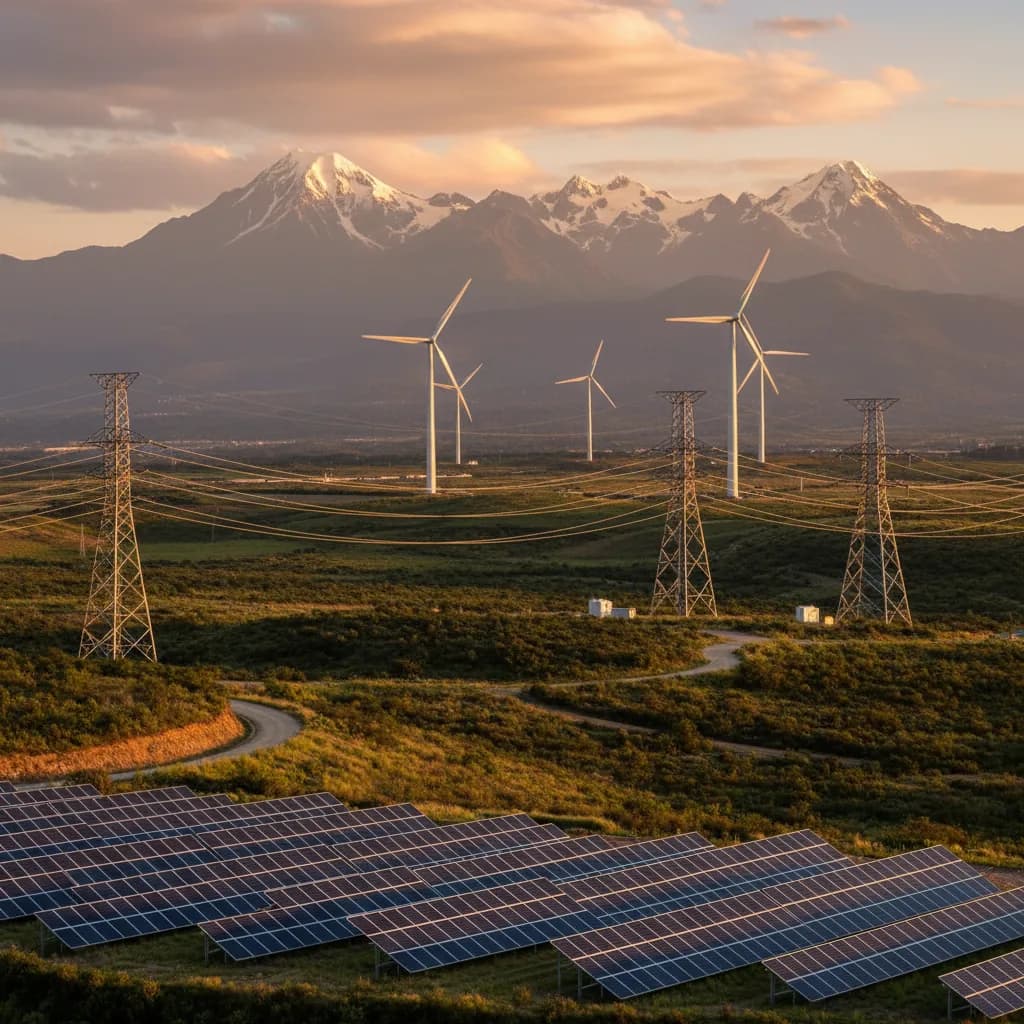
$2.43B Renewable Energy Expansion Plan — 1,471 MW, Solar Dominates at 963 MW

The Plan
Ecuador's government unveiled a $2.43 billion renewable energy expansion plan targeting 1,471 MW of new generating capacity, with solar photovoltaic projects dominating at 963 MW (65%) of the total. The plan responds directly to the power crisis of 2024-2025, when drought-reduced hydroelectric output caused months of rolling blackouts that cost the economy an estimated $1-2 billion in lost productivity.
Capacity Breakdown
| Technology | Capacity (MW) | Investment (est.) | Share |
|---|---|---|---|
| Solar PV | 963 | ~$1.4B | 65% |
| Wind | 258 | ~$500M | 18% |
| Biomass/biogas | 150 | ~$280M | 10% |
| Small hydro | 100 | ~$250M | 7% |
| Total | 1,471 | ~$2.43B | 100% |
Solar's dominance reflects Ecuador's favorable irradiance conditions — particularly in the highlands and coastal regions — combined with rapidly declining global panel costs that make solar the cheapest new-build generation technology.
Current Power Matrix
Ecuador's electricity generation is heavily concentrated in hydroelectric:
| Source | Share of Generation | Installed Capacity |
|---|---|---|
| Hydroelectric | ~80% | 5,100 MW |
| Thermal (gas/diesel) | ~17% | 2,800 MW |
| Wind | ~1.5% | 21 MW |
| Solar | ~0.5% | 27 MW |
| Biomass | ~1% | 144 MW |
The 1,471 MW expansion would increase non-hydro renewable capacity from approximately 192 MW to 1,663 MW — a transformational shift that reduces drought vulnerability and aligns with global energy transition trends.
Investment Framework
The government is structuring the expansion through a combination of:
- Competitive auctions — international bidding rounds for utility-scale solar and wind projects
- PPAs (Power Purchase Agreements) — long-term contracts that provide revenue certainty for private investors
- Multilateral financing — IDB, CAF, and World Bank climate finance facilities
- Private equity — including potential participation from UAE's Masdar under the newly signed CEPA
What to Watch
- Auction timeline — the first competitive bidding round for solar capacity is expected in Q3 2026; execution pace will determine whether the 2028-2030 targets are achievable
- Grid integration — adding 1,471 MW of variable renewable energy requires transmission upgrades and potentially battery storage investment not yet included in the plan
- Masdar and Gulf investors — the UAE CEPA creates a direct channel for Gulf clean energy capital; Masdar has deployed over $30B globally in renewables
- La Niña cycle — favorable hydrological conditions in 2026 reduce the urgency for emergency thermal generation but do not eliminate the structural vulnerability
Sources: New Energy Events
Support daily Ecuador business intelligence.
Research support funds source monitoring, data checks, editing, publishing, and sector coverage for professionals tracking Ecuador.