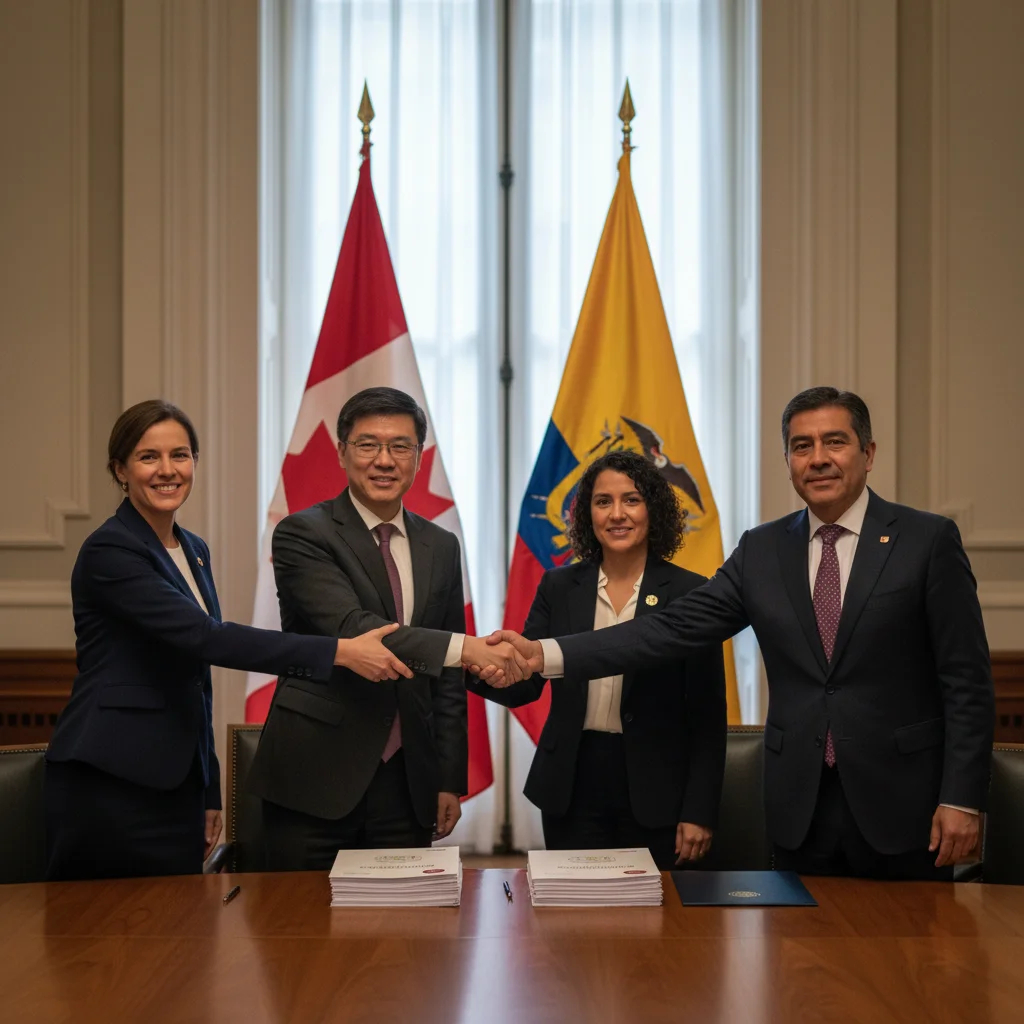
Canada and Ecuador Conclude Free Trade Agreement Negotiations After Six Rounds; Ratification Pending

Canada and Ecuador Conclude Free Trade Agreement Negotiations
Canada and Ecuador formally concluded negotiations on a comprehensive free trade agreement (FTA) during the sixth and final round of talks held in Quito in January 2025, the Government of Canada's trade ministry confirmed. The agreement now enters a legal scrubbing and translation phase before being submitted to both the Canadian Parliament and Ecuador's National Assembly for ratification.
Negotiations launched in April 2024 and proceeded at an accelerated pace -- unusually fast by FTA standards -- completing in nine months across six rounds alternating between Ottawa and Quito.
Market access commitments
The agreement's core market access provisions reflect the asymmetric tariff structures between the two economies:
| Metric | Canada | Ecuador |
|---|---|---|
| Average applied tariff | 3.2% | 6.8% |
| Tariff lines eliminated | 98.1% | 97.2% |
| Transition period | Immediate for most | Up to 10 years for sensitive goods |
| Key sensitive exclusions | Dairy, poultry (supply-managed) | Certain processed foods, textiles |
Ecuador's average tariffs are more than double Canada's (6.8% vs. 3.2%), meaning Ecuadorian exporters stand to gain proportionally more from the tariff elimination on the Canadian side, while Canadian exporters benefit from access to a market with higher baseline protections.
Current bilateral trade profile
Existing trade between the two countries is heavily concentrated in agricultural commodities:
Ecuador to Canada (top exports):
- Bananas and plantains -- $185M (2024)
- Shrimp and prawns -- $142M
- Cocoa beans -- $67M
- Canned tuna -- $43M
- Cut flowers -- $38M
Canada to Ecuador (top exports):
- Wheat -- $89M (2024)
- Lentils and pulses -- $52M
- Cereals -- $34M
- Machinery and equipment -- $28M
- Paper and cardboard -- $21M
Total bilateral merchandise trade was valued at approximately $780 million in 2024, a figure both governments expect to grow by 25-35% within five years of the FTA's entry into force.
Strategic context: diversification from the US
The FTA carries strategic significance that extends well beyond its bilateral trade value. Both nations are actively pursuing trade diversification in response to escalating US tariff policies under the Trump administration.
For Canada, the Ecuador FTA is part of a broader effort to reduce dependence on the United States, which accounts for approximately 75% of Canadian exports. Ottawa has accelerated trade negotiations with multiple partners since the re-imposition of US tariffs on Canadian goods, viewing Latin America as a priority diversification corridor.
For Ecuador, the agreement complements a parallel strategy to reduce vulnerability to US trade policy shifts. The Ecuador-US trade relationship has been disrupted by the 15% tariff increase on Ecuadorian goods (see Article 24), making alternative market access strategically important. Ecuador has simultaneously concluded or advanced FTA negotiations with China, the European Union (existing), South Korea, and the United Arab Emirates (CEPA).
ProEcuador, the country's trade promotion agency, has identified Canadian market opportunities in:
- Value-added cocoa products (chocolate, cocoa butter, powder)
- Specialty seafood (premium shrimp, tuna loins)
- Tropical fruits (dragon fruit, passion fruit, mango)
- Flowers (roses, gypsophila)
Ratification pathway
The agreement requires ratification by both legislatures. In Canada, the process typically takes 12-18 months and includes review by the Standing Committee on International Trade. In Ecuador, the National Assembly must approve the agreement by simple majority vote, though the current legislative calendar is congested with the mining reform bill and other priority legislation.
Analysts estimate the FTA could enter into force by late 2026 or early 2027, assuming no significant political obstacles in either capital.
What to watch
Monitor the ratification timeline in both legislatures, particularly whether Ecuador's Assembly prioritises the FTA alongside competing legislation. The Canadian dairy and poultry lobby's response to the agreement's agricultural provisions will signal whether domestic opposition could delay ratification in Ottawa. ProEcuador's trade promotion budget allocation for the Canadian market in its 2026-2027 operational plan will indicate how aggressively Ecuador intends to capitalise on the new market access.
Sources: Government of Canada, Global News, ProEcuador
Source
Government of Canada / Global News — "Canada and Ecuador conclude free trade agreement negotiations"
View originalSupport daily Ecuador business intelligence.
Research support funds source monitoring, data checks, editing, publishing, and sector coverage for professionals tracking Ecuador.
