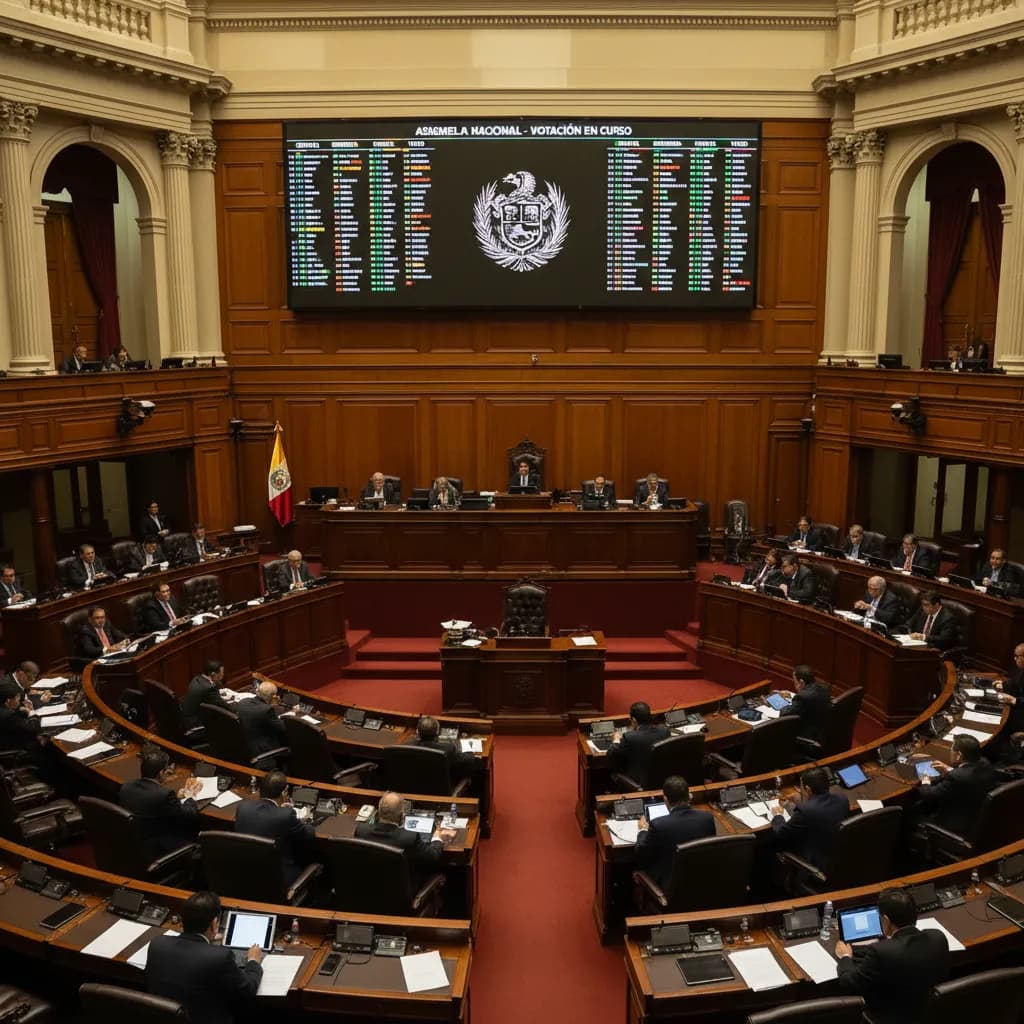
National Assembly Votes 148-0 to Censure Judiciary Chief Mario Godoy After Resignation Gambit Fails, Two-Year Public Office Ban Imposed

Unanimous Censure
Ecuador's National Assembly voted 148-0 (with one abstention) to censure and dismiss Mario Godoy as president of the Consejo de la Judicatura — the governing body of Ecuador's judiciary. The vote also imposes a two-year ban on Godoy holding any public office.
The unanimous result — spanning the ruling ADN party, opposition Correísmo bloc, and independent legislators — represents one of the most decisive political trials in recent Assembly history.
Timeline of Events
| Date | Event |
|---|---|
| Early February 2026 | Allegations surface of Godoy pressuring anticorruption judge |
| February 14 | Assembly announces political trial proceedings |
| February 18, ~9:00 AM | Godoy submits resignation letter |
| February 18, ~10:00 AM | Political trial begins as scheduled |
| February 18, ~4:00 PM | Assembly votes 148-0 to censure despite resignation |
| February 18 | Two-year public office ban takes effect |
Godoy's last-minute resignation — submitted approximately one hour before the trial was scheduled to begin — was widely interpreted as an attempt to preempt the censure vote and preserve his eligibility for future public appointments. The Assembly's decision to proceed regardless sets a precedent that resignation does not shield officials from accountability.
Allegations
The political trial centered on two primary charges:
1. Manifest Negligence
- Failure to address systemic corruption within the judiciary
- Inadequate oversight of judicial appointments and disciplinary processes
- Neglect of institutional modernization commitments
2. Judicial Interference
- Alleged pressure on an anticorruption judge to issue a favorable ruling for a detained Serbian narcotrafficker
- The specific case involved a criminal proceeding in Quito where the defendant sought pretrial release
- Legislators cited evidence of phone communications between Godoy's office and the presiding judge
Cross-Party Consensus
| Political Bloc | Votes to Censure | Context |
|---|---|---|
| ADN (ruling party) | Full support | Noboa government distanced itself from Godoy |
| Correísmo | Full support | Opposition seized on judicial corruption narrative |
| PSC | Full support | Aligned with institutional accountability |
| Independents | Full support | Single abstention, no votes against |
The 148-0 result is remarkable in Ecuador's typically fractured political landscape, where even consensus legislation rarely achieves more than 90-100 votes. The unanimity suggests the evidence presented during the trial was considered overwhelming.
Impact on Judiciary Governance
The Consejo de la Judicatura oversees Ecuador's entire judicial branch, including:
| Function | Scope |
|---|---|
| Judge appointments | ~2,200 judges nationwide |
| Disciplinary proceedings | Investigations of judicial misconduct |
| Court administration | Budget allocation, infrastructure |
| Judicial training | National School of the Judiciary |
| Technology | Digital case management systems |
Godoy's removal creates a leadership vacuum at a critical moment. Ecuador's judiciary faces enormous pressure from the security crisis — with 150,000 people detained under the ongoing internal armed conflict but only 10,000 processed through the courts, according to President Noboa's own assessment. The judicial backlog represents a direct threat to both security outcomes and investor confidence in the rule of law.
Business Environment Implications
Judiciary governance directly affects Ecuador's investment climate through several channels:
| Channel | Impact |
|---|---|
| Contract enforcement | International arbitration clauses remain standard due to weak domestic courts |
| Mining/energy permits | Environmental and concession disputes bottleneck in judicial system |
| Anti-money laundering | Judicial capacity constrains prosecution of financial crimes |
| Property rights | Title disputes and expropriation cases face multi-year delays |
| Regulatory certainty | Constitutional challenges to economic laws depend on judicial independence |
The World Bank's Doing Business indicators (now B-READY) have consistently flagged Ecuador's judicial efficiency as a constraint on the business environment, particularly regarding enforcing contracts and resolving insolvency.
Broader Institutional Context
Godoy's censure follows a series of institutional accountability actions in early 2026:
- Guayaquil Mayor Aquiles Alvarez arrested on organized crime charges (February 10)
- SNAI prison director replaced following prison death crisis
- Mining regulatory crackdown with operations suspended in three provinces
- National Assembly asserting oversight authority across multiple agencies
Whether these actions represent genuine institutional strengthening or politically motivated targeting remains debated among analysts. Critics note that several targets — including Mayor Alvarez — are political opponents of President Noboa.
What to Watch
Track the appointment of Godoy's successor — the new Judicatura president will inherit the judicial backlog crisis and ongoing reform agenda. Monitor the judicial processing rate — the gap between 150,000 detained and 10,000 processed represents a constitutional and human rights liability. Watch for international assessments — the Inter-American Commission on Human Rights and international rating agencies will evaluate whether the censure strengthens or disrupts judicial independence. Track foreign investment sentiment — judicial governance quality is a key input in sovereign risk assessments, and the resolution of this crisis could move the needle on rule-of-law indicators.
Sources: Primicias, El Universo
Source
Primicias / El Universo — "La Asamblea censuró y destituyó a Mario Godoy, pese a su renuncia a la Judicatura"
View originalSupport daily Ecuador business intelligence.
Research support funds source monitoring, data checks, editing, publishing, and sector coverage for professionals tracking Ecuador.