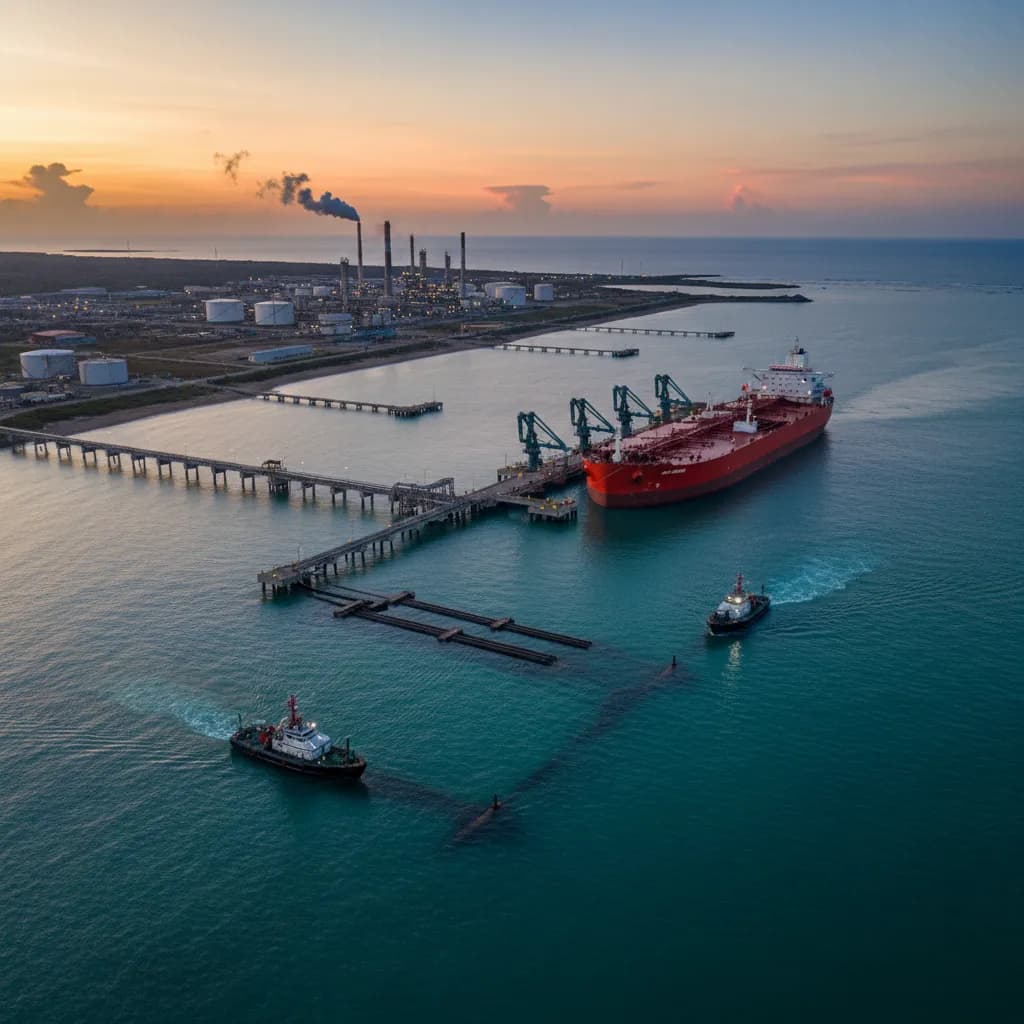
Petroecuador Declares Force Majeure at Esmeraldas Maritime Terminal After Tanker Strikes Submarine Pipeline, Disrupting Fuel Supply to Northern Ecuador

Force Majeure Declared
EP Petroecuador declared force majeure and emergency at the Esmeraldas Maritime Terminal on February 14, 2026, following a pipeline collision incident six days earlier.
On February 8, the tanker "Seaways Wheat" struck a submarine pipeline during a diesel discharge operation at the terminal. The collision was caused by adverse weather conditions — high seas and strong currents — that displaced the vessel during the unloading process.
The emergency period extends for 60 days, during which Petroecuador will implement alternative fuel supply arrangements for the affected region.
Incident Details
| Metric | Detail | |---|---|---| | Date of incident | February 8, 2026 | | Declaration date | February 14, 2026 | | Emergency duration | 60 days | | Vessel | Tanker "Seaways Wheat" | | Cause | Adverse weather displaced vessel during discharge | | Infrastructure damaged | Submarine fuel discharge pipeline | | Fuels affected | Premium Diesel, Ron 95 Gasoline, Diesel Oil | | Location | Esmeraldas Maritime Terminal |
Terminal Significance
The Esmeraldas Maritime Terminal is Ecuador's primary fuel import facility for the northern region, serving both the northern coastal provinces (Esmeraldas, northern Manabí) and the northern highlands (Carchi, Imbabura, northern Pichincha):
| Terminal Function | Detail | |---|---|---| | Primary role | Fuel import reception for northern Ecuador | | Adjacent facility | Esmeraldas Refinery (~110,000 bbl/d capacity) | | Fuels handled | Premium Diesel, Ron 95 Gasoline, Diesel Oil, LPG | | Region served | Northern coast and highlands | | Population served | ~3-4 million residents | | Industrial users | Agriculture, transport, fishing fleets |
Esmeraldas Refinery Context
The terminal operates alongside the Esmeraldas Refinery — Ecuador's largest, with a nominal capacity of approximately 110,000 barrels per day. However, the refinery has operated well below capacity for years due to maintenance backlogs and equipment degradation:
| Refinery Metric | Value | |---|---|---| | Nominal capacity | ~110,000 bbl/d | | Typical operating rate | ~60-70% of capacity | | Effective throughput | ~65,000-77,000 bbl/d | | Products | Gasoline, diesel, fuel oil, LPG | | Crude source | Oriente crude via SOTE pipeline |
The refinery's chronic underperformance means Ecuador must import significant volumes of finished fuels to meet domestic demand — making the maritime terminal a critical supply chain node. Any disruption at the terminal directly affects fuel availability in the northern region.
Supply Chain Vulnerability
Ecuador's fuel supply chain faces a structural paradox — the country exports crude oil but imports refined products because domestic refining capacity is insufficient:
| Fuel Balance (2025-2026) | Metric | |---|---|---| | Crude oil production | ~480,000-500,000 bbl/d | | Crude oil exports | ~350,000 bbl/d | | Domestic refining | ~130,000 bbl/d (all refineries) | | Fuel imports | ~100,000+ bbl/d equivalent | | Import cost | $3+ billion annually |
A February 2026 analysis noted that Ecuador "now imports almost as much fuel as it exports in crude" — highlighting the strategic vulnerability that the Esmeraldas terminal disruption exposes.
Alternative Supply Routes
During the 60-day emergency, Petroecuador is expected to reroute fuel supplies through:
| Alternative | Route | Limitation |
|---|---|---|
| Balao terminal | Esmeraldas province | Primarily crude export, limited fuel import capacity |
| La Libertad | Santa Elena province | Serves central/southern coast |
| Guayaquil maritime | Guayas province | Additional trucking distance to north |
| Overland from Quito | Tank trucks | Limited volume, higher cost |
Each alternative involves higher logistics costs and longer transit times, potentially affecting fuel pricing and availability in the northern region during the emergency period.
What to Watch
Track fuel availability and pricing in Esmeraldas, Carchi, and Imbabura provinces — spot shortages or price spikes would signal inadequate alternative supply arrangements. Monitor pipeline repair timeline — the 60-day emergency window suggests Petroecuador expects repairs to take at least two months. Watch for Flopec (Ecuador's state tanker company) rerouting — the national fleet may need to redirect tanker movements to compensate. Track refinery utilization rates — if Esmeraldas Refinery can temporarily increase throughput, it could partially offset the import disruption. Monitor agricultural sector impact — the northern coast's palm oil, cocoa, and fishing industries depend on diesel availability.
Sources: Radio Govea, Expreso, Petroecuador
Source
Radio Govea / Expreso / Petroecuador — "Petroecuador declara fuerza mayor y emergencia en el Terminal Maritimo Esmeraldas"
View originalSupport daily Ecuador business intelligence.
Research support funds source monitoring, data checks, editing, publishing, and sector coverage for professionals tracking Ecuador.
