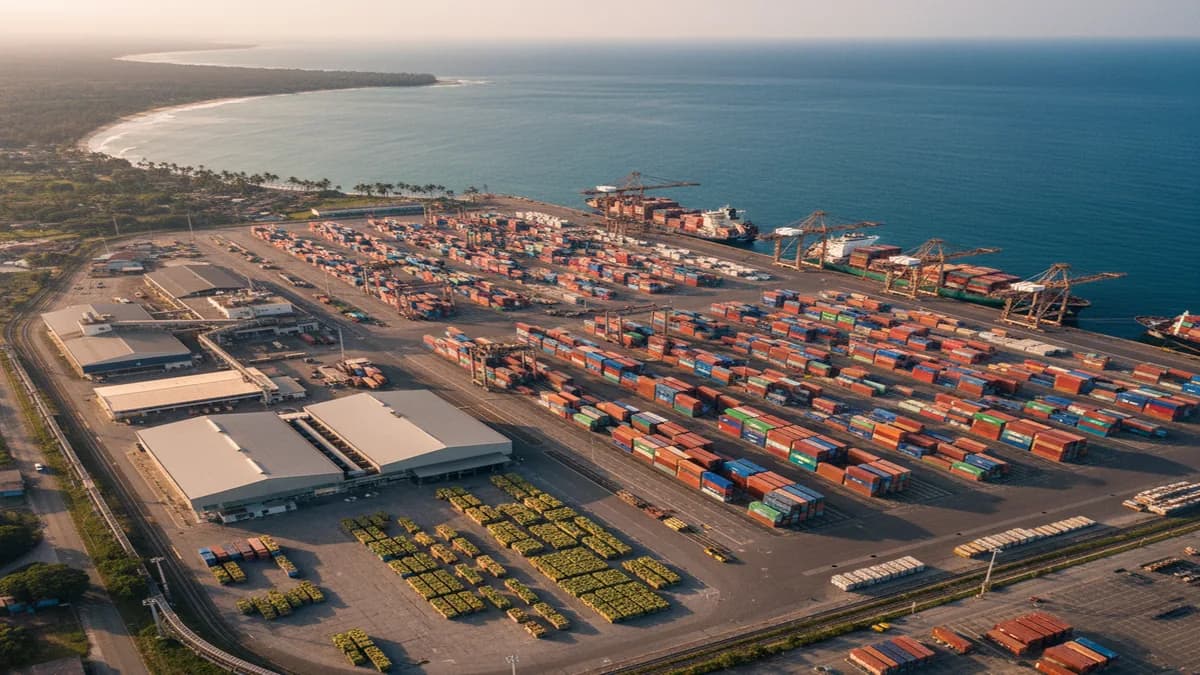
Ecuador Banana Exports Reach 247.08 Million Boxes Through July

Ecuador exported 247.08 million boxes of bananas between January and July 2026, an 8.36% increase over the 228.02 million boxes shipped in the same period of 2025. The volume keeps bananas at the center of Ecuador's non-oil export and logistics system.
Foreign-exchange contribution
The Central Bank of Ecuador reported around $2.3608 billion in banana and plantain export sales between January and June 2026. That was 6% above the same period of 2025 and represented 16.1% of non-oil exports.
The sector's relevance extends beyond farms. The source identifies producers, packing plants, transport, ports, logistics, financial services, and input industries as part of the chain. In a dollarized economy, the export flow is also a source of dollars entering Ecuador.
Destination mix
| Destination | Share of shipments through July |
|---|---|
| European Union | 32.78% |
| Russia | 19.86% |
| Middle East | 15.40% |
| United States | 11.45% |
Shipments to Europe increased 14.78%, and shipments to Russia increased 11.96%. Sales to the United States decreased 5.62%.
China received 10.61 million boxes, up 7.04% from a year earlier. The report cites a 27-day maritime route between Guayaquil and Shanghai and a reduction in Ecuador's banana tariff from 10% to 7% in 2026.
Temporary advantage or durable position?
The export increase did not come only from internal improvements. The source attributes part of the opportunity to greater Ecuadorian fruit availability and climate or phytosanitary problems that reduced supply from competitors including Costa Rica, Colombia, the Philippines, Cambodia, Vietnam, and China.
The commercial picture is consequently mixed. Ecuador has more boxes in the reported period and a large share of shipments going to the European Union and Russia, but the same source identifies external supply conditions, transport, security, and disease as variables that can change the result. Volume growth is the observed outcome; durability is the question still to be tested.
That creates a strategic question for exporters: whether the additional market share can remain after competing producers recover. The source identifies the challenge as turning a temporary opportunity into a more permanent market position.
The risk register
Climate, disease, insecurity, freight costs, logistics, and geopolitical conflict all remain relevant. More rain can favor Black Sigatoka and increase production costs. Conflict in the Middle East can also affect logistics, containers, transport costs, and insurance.
The next question is not simply whether Ecuador ships more boxes. It is whether the country converts current volume into durable destination access, stronger productivity, biosecurity, and value per box.
That is why the destination table matters alongside the headline shipment number. The European Union and Russia together account for the largest stated shares, while the United States moved in the opposite direction during the reported period. China adds a separate route and tariff signal, with the report linking the market to the 27-day Guayaquil-Shanghai route and the lower 2026 tariff.
Source: El Comercio
Source
El Comercio — "El banano de Ecuador acelera sus exportaciones y mueve la economia en el primer semestre del 2026"
View originalSupport daily Ecuador business intelligence.
Research support funds source monitoring, data checks, editing, publishing, and sector coverage for professionals tracking Ecuador.